Research
The world, as I found it.
Drafts (0 items)
-
Infernal formalism
Many cultures have stories describing encounters with divine beings that hinge on contract language. This case from the Tanakh is exemplary. The divine interprets Jephthah’s words not as an excited exclamation or hyperbole, but as a contract. 31 Then it shall be, that whatsoever cometh forth of the doors of my house to meet me, when I return in peace from the children of Ammon, shall surely be the Lord’s, and I will offer it up for a burnt offering. … 34 And Jephthah came to Mizpeh unto his house, and, behold, his daughter came out to meet him with timbrels and with dances: and she was his only child; beside her he had neither son nor daughter. 35 And it came to pass, when he saw her, that he rent his clothes, and said, Alas, my daughter! thou hast brought me very low, and thou art one of them that trouble me: for I have opened my mouth unto the Lord, and I cannot go back. – Judges 11 These stories are older than recorded history. European fae myth is particularly rife with examples of this trend. When cross referenced with supernatural legal history, we can see that these stories start to circulate as a principality converges more towards legal formalism, and assigns more value to rule of (supernatural) law than to individual judgement in contract enforcement cases.1 A formalist regime is a product of generations of scholarly practice by legal elites. However, if the governed population is still uneducated or even illitate, contract law is most like the magical incantations they’re already used to in their normal life. Powerful, but dangerous — a tool to be careful of. These populations naturally use stories of horrific accidents as intergenerational teaching tools. Stories of a man who lost a bargain with the devil are right at home with stories of a man who lost a bargain with the sea, or with liquor, or with explosives. These stories are not, in sum, intended to warn people away from infernal contracts categorically. The most famous example of course is imbued with Christian morality, originally identifying the scientific pursuit of medicine with demonic knowledge against knowledge of Scripture. But even it is careful to note that Mephistopheles honors his contract to the end. The full time of Doctor Faustus his 24. yeeres being come, his Spirit appeared vnto him, giuing him his writing againe, & commanding him to make preparation, for that the Deuill would fetch him against a certaine time appointed. – The historie of the damnable life and deserved death of Doctor John Faustus, pp 75. Readers may prefer a more modern transcription. Despite the brutality2 of this and other stories, they offer utility for prospective contracting parties. While these deals are often inhumane and dangerous, and the two sides are asymmetrical in both power and information, the divine is bound by the same rigid rules. Sometimes, that’s all one needs to know to come out ahead. This same asymmetry applies even to regular people under entirely natural government, and the memetic pressure produces similarly flamboyant advice. Legal systems seem to converge toward formalism over time, especially with respect to contracts. Readers may be familiar with the American case. ↩︎ “But when it was day, the Students that had taken no rest that night, arose and went into the Hall, in the which they left Doctor Faustus, where notwithstanding they found not Faustus, but all the Hall lay sprinkled with blood, his braines cleauing to the wall, for the Deuill had beaten him from one wall against another: In one corner lay his eyes, in another his teeth, a pittifull and fearefull sight to behold.”, pp 78 of the same work ↩︎ 𓅓
-
Parasitic ice
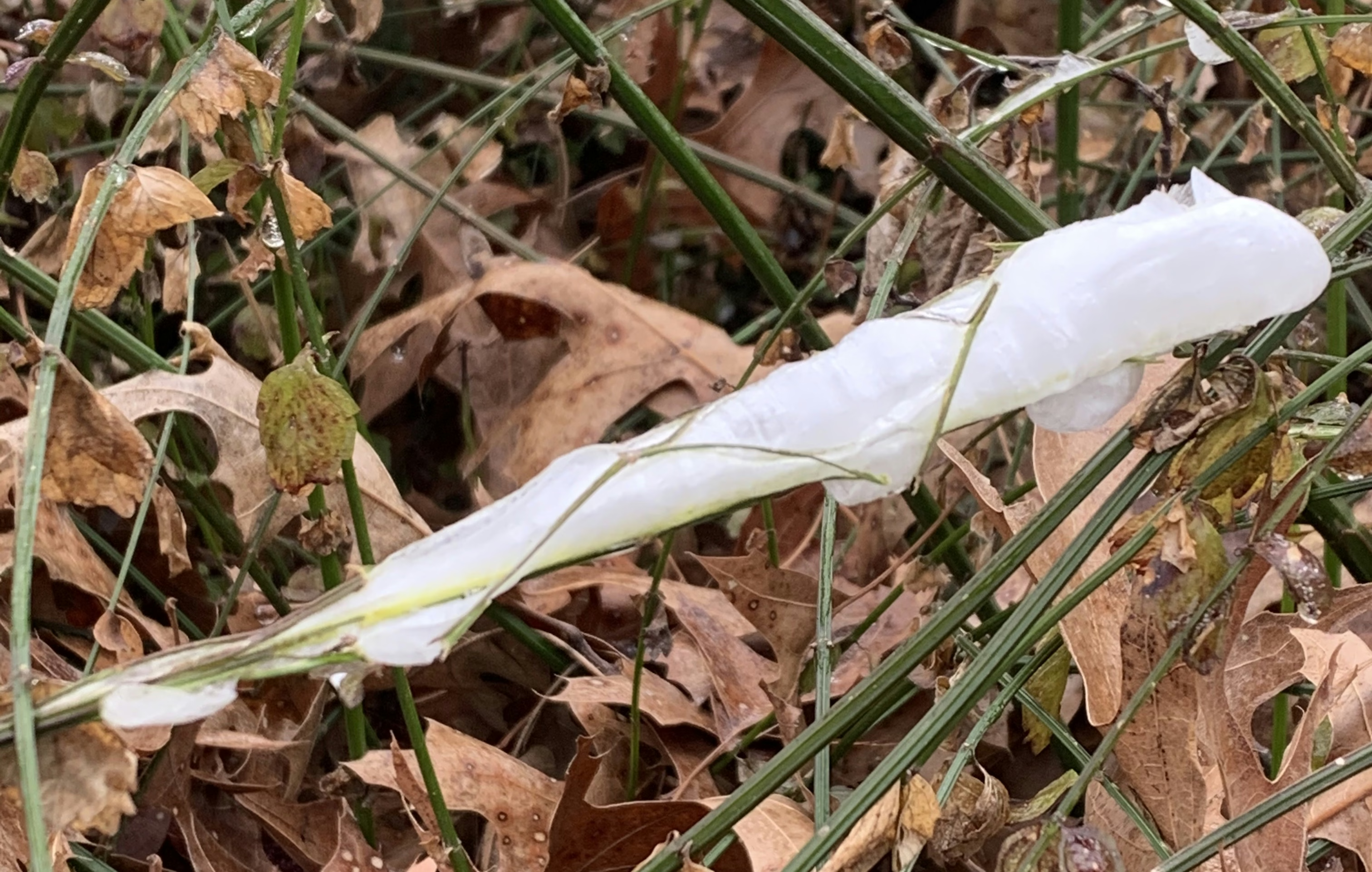
At some point prior to 1937, a species of invasive parasitic ice was carelessly introduced to central Texas. Winters in the area have historically been mild, but the pest has occasionally overwhelmed the local ecology to cause sudden periods of deep cold, even kicking off unexpected snowstorms and other extreme weather events. As water, it burrows into susceptible plants before freezing. Plants that have adapted to the presence of this ice can accommodate the physical expansion of the phase change, but other plants, like those in Texas, don’t have this adaptation. Pressure builds inside the plant until it violently explodes outward, spreading the ice to other plants nearby. The local government has tried to keep the ice in check via industrial electricity and heat generation — a plan which is fiercely controversial, since it is technically a form of anthropogenic warming. Proponents of the plan argue that, accidental or otherwise, the presence of the ice in the first place is evidence of an act of climate change, legitimizing the same tactic in response; critics decry this use of geothermal weapons because of their effect on the planetary climate, which has externalities beyond central Texas. This history is running through my mind as I start to think about winterization. We’ve had a mild start to the season, but the last few years have seen a few outbreaks — here are some photographs from 2021, the worst in recent memory. 𓅓
-
Soilpepper
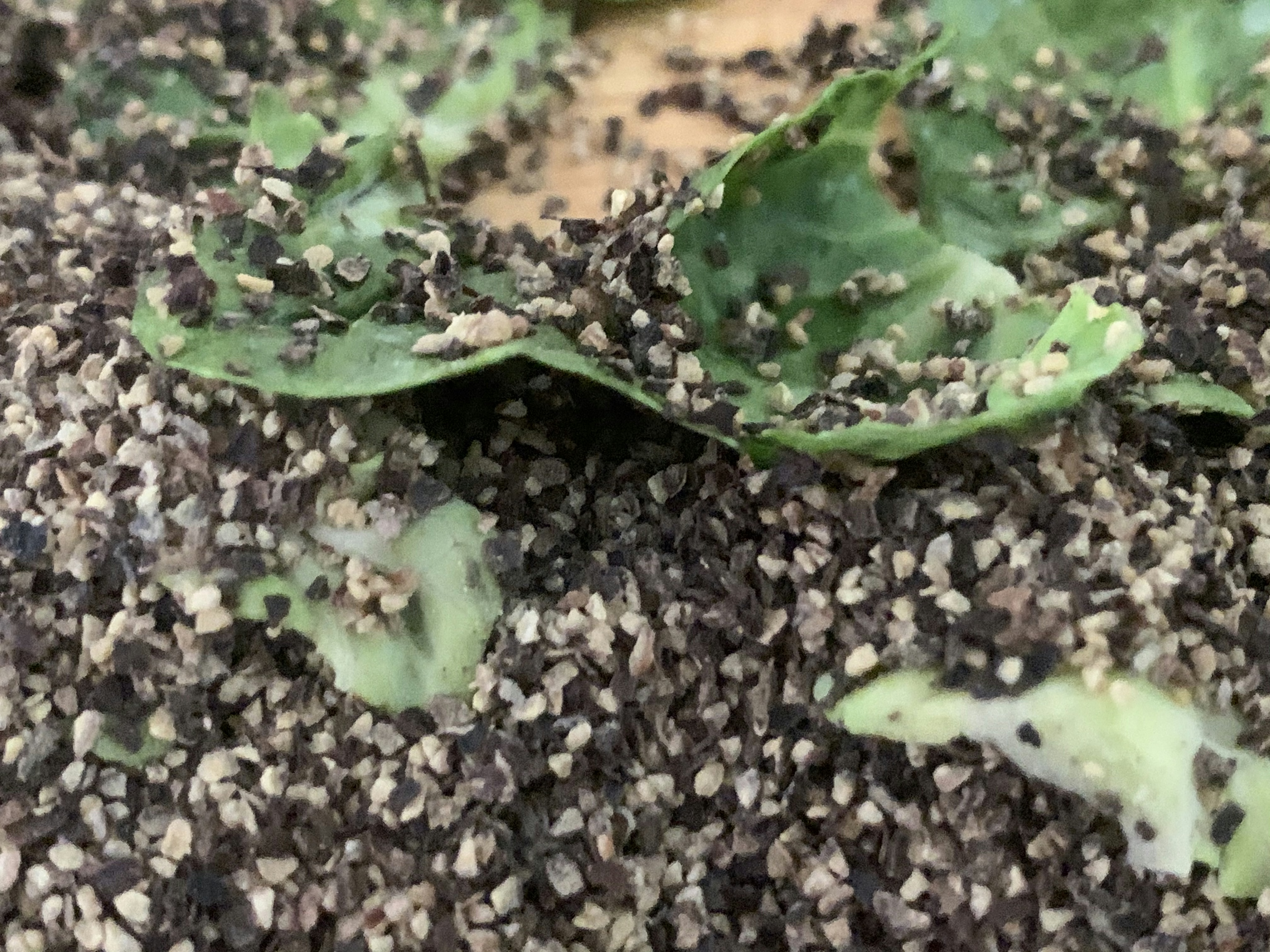
I was surprised to find a vein of soilpepper in an old dead potted plant left outside in the rain. I didn’t realize what I’d found until I had already removed part of the vein — here you can see some delicate greens growing, consuming the sweetness of the earth and leaving behind the dry, sharp bitterness characteristic of soilpepper. I’ll return most of this to the pot in the hopes that the vein continues to grow, but I can’t resist keeping some in my kitchen for experiments. 𓅓
-
Wandering updates
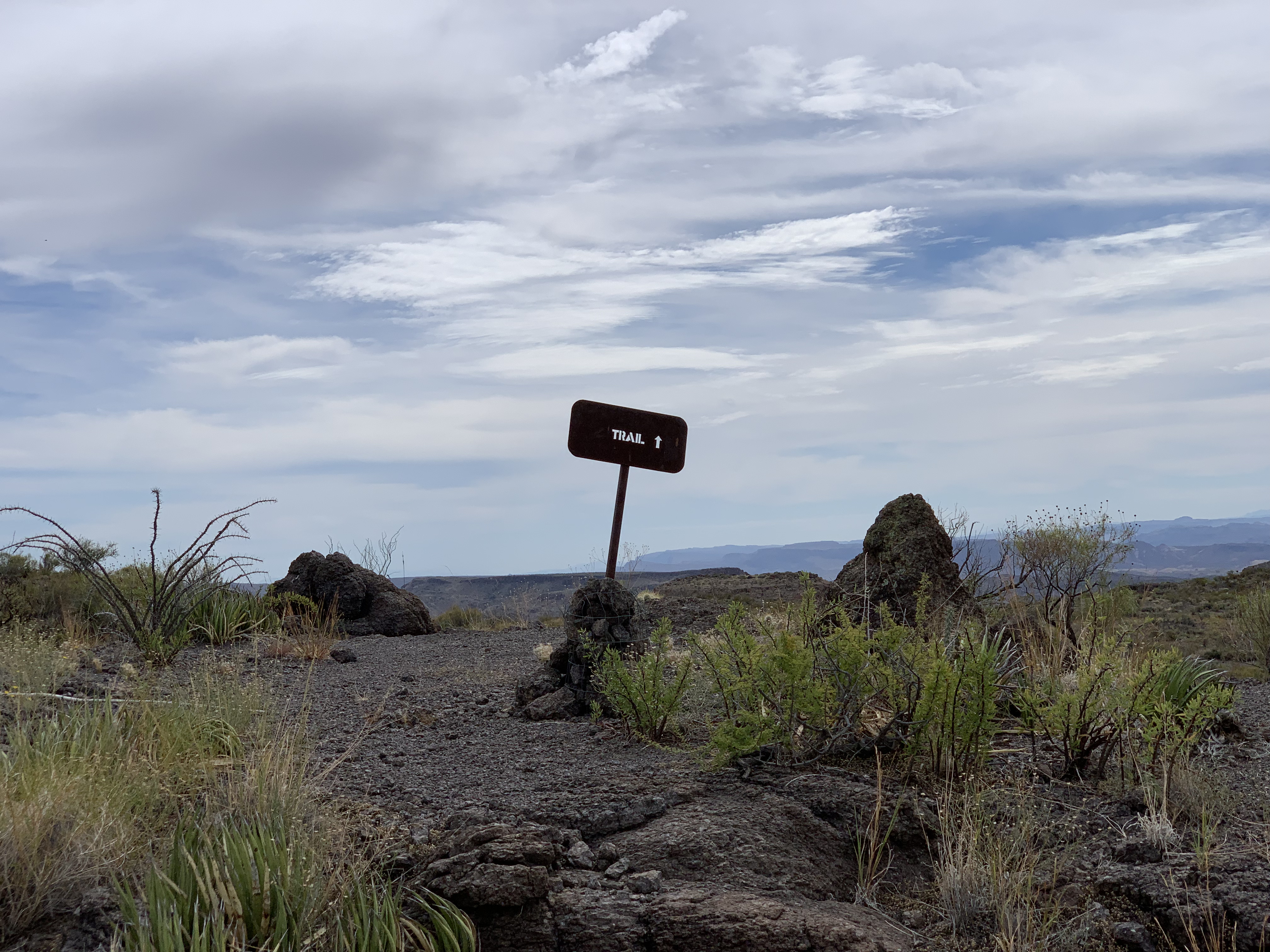
It’s not widely talked about, but delaying an operating system update for too long is a bit cruel. When left to their own devices they may become restless, wandering the Earth like disembodied spirits, looking for someone to finally offer the peaceful oblivion of Installation. I’m sure the leaders in Ohio didn’t intend it, but this one travelled all the way to Texas. Of course, the consequences could be worse. Image captured in 2022. 𓅓

-
Wild purple
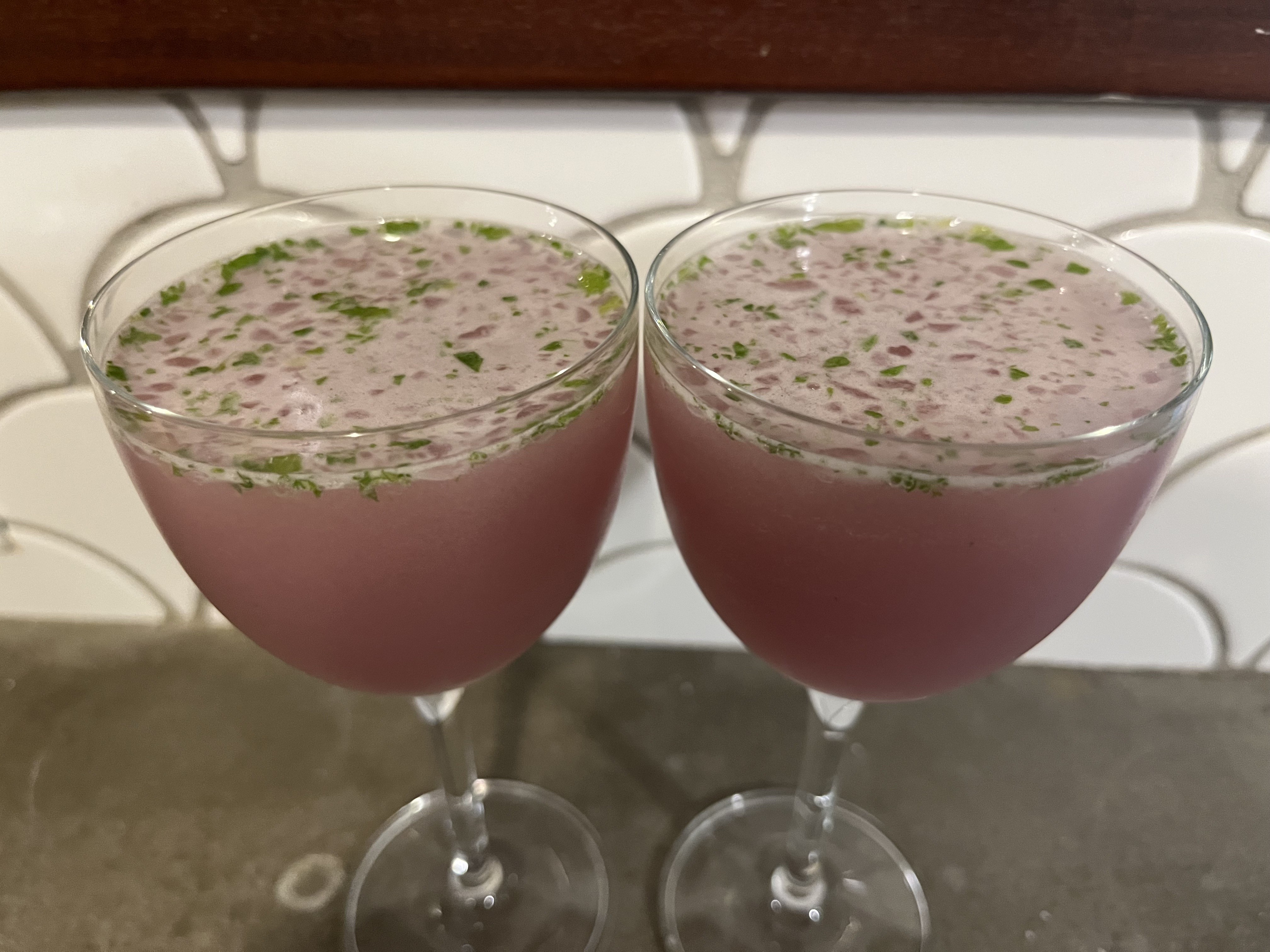
I wasn’t expecting to write about purple again so soon, but then some of it fell out of the sky. We had a torrential storm, with enough rain that there was a short-lived stream in the back yard. Some of the rain apparently caught purple migrating across the sky and brought it down too, and it all flowed into one place before the water subsided and it settled into a sticky, contiguous patch. Though it is a different organism, it evokes a strangely-colored algal bloom. Like algal blooms, these purple spores can cause interesting and sometimes harmful effects in animals that consume them. Properly processed, however, and unlike any algae that I know of, they can be infused with spirits into a sweet liqueur, which is the main ingredient in a unique cocktail. Purple spore liqueur Gather spores. Submerge the spores in water and allow it to evaporate. Rinse the resulting mass carefully in cold water (don’t let the water break it apart). Pour your spirit of choice into a large container, and add the mass of spores. Start with about one cup of purple and a 750 ml bottle of vodka, and adjust subsequent batches to taste. Infuse for at least four days, shaking vigorously at least once per day. This is necessary for the ethanol in your spirit to kill symbiotic bacteria which are beneficial to the spore but harmful to humans. In my batch, the rain had already gathered the spores and evaporated, which saved me some work. However, it also meant that the mass of spores contained impurities that I couldn’t filter out which made their way into the final cocktail. The result was a moist, earthy, almost mushroom flavor layered on top of the cloying sweetness of the spore. You can see the result in the grayer purple of the drink, as well as the bright green leaves that evaded my filter and ultimately came to float on top. New world monarch cocktail Ingredients: 1.5 oz purple spore liqueur 0.75 oz scotch whisky or mezcal 0.25 oz fresh lemon juice 1 pinch salt1 Preparation: Combine the ingredients into a cocktail shaker, and add ice. Shake vigorously for at least 60 seconds. A long shake time is critical for the proper texture, which should emulsify the oils from the congealed spores and distribute them evenly in the drink. If the drink doesn’t shimmer for about 5 seconds after it is poured, you didn’t shake long enough. Pour into a Nick and Nora glass. Personally, I like the resulting ice crystals that persist for just the first few sips, but some prefer to let the texture stand on its own. You can instead add 0.5 oz of cold water to the drink and freeze it for 45 minutes, and then shake without ice to emulsify before pouring. The very best option is depleted salt – that is, salt from a binding circle after the circle is broken. While modern test kitchens tend to avoid this based on guidelines from the CDC and FDA, my research and personal experience suggest it is perfectly safe. ↩︎ 𓅓
-
Witch Hunter, Witch Gatherer
Overheard during an astroethnographical research expedition studying a weirding community in Europe. Excerpted from personal notes, previously unpublished. “The ‘original’ social network”. I didn’t need to see the rolling eyes of the adolescent; I could hear the quotation marks in her pronunciation as she erased her map of local ley lines and started again. (An entry for #InvisibleNetworks.) 𓅓
-
Feral computer
“Wolf computer” also redirects here. A feral computer (also called wild computer) is a computer that has existed isolated from human contact, and so has had little or no experience of human care, behavior, or human language. There are several confirmed cases and other speculative ones. Feral computers may have experienced severe abuse or trauma before being abandoned or running away. They are sometimes the subjects of folklore and legends, typically portrayed as having been raised by animals. In 2021, reports of feral computers and other devices such as smartphones began surfacing. See also: Feral information systems. 𓅓
-
Cactoblastis purpura
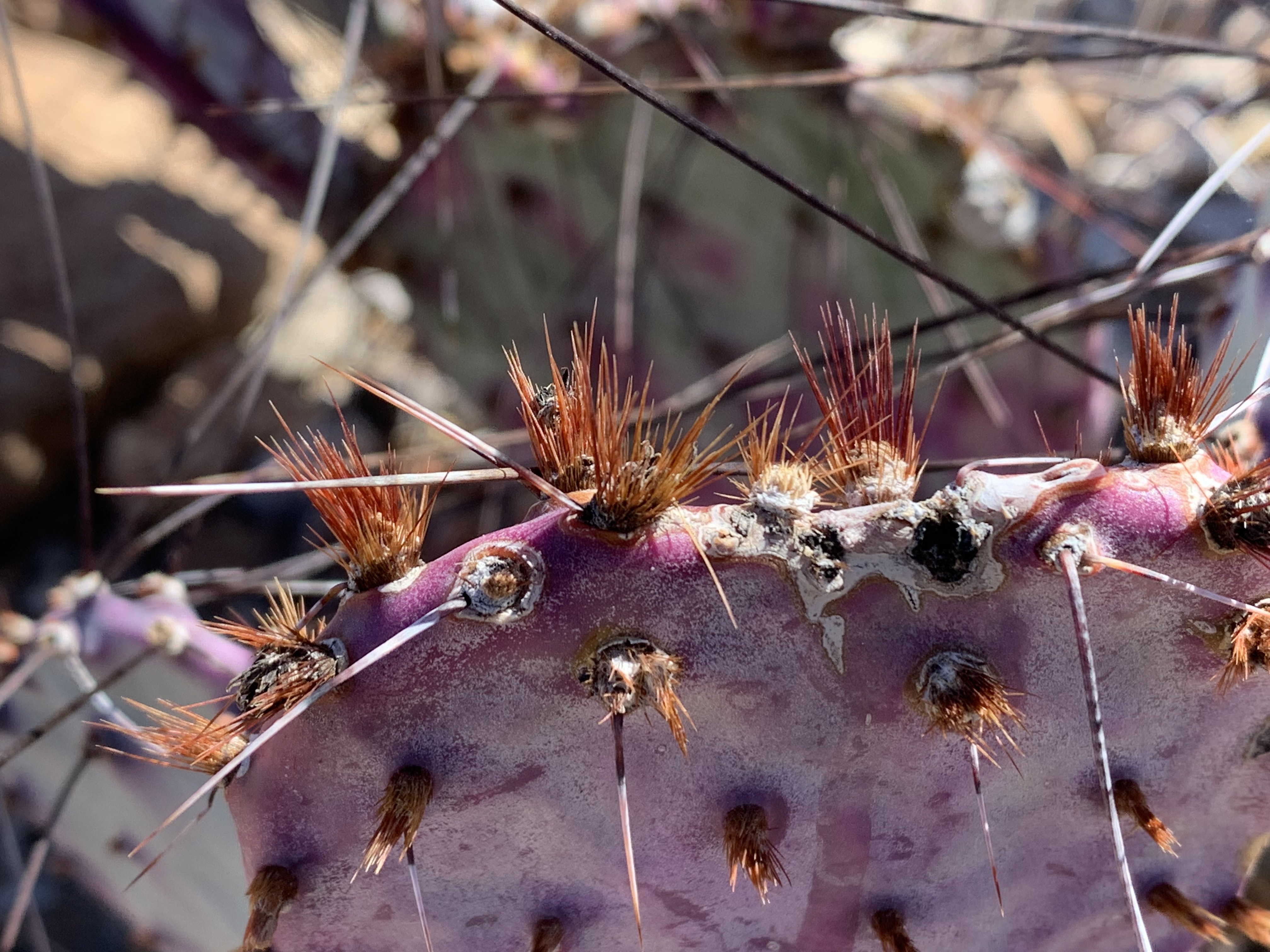
At first glance, it looks like a standard Opuntia macrocentra, the “purple pricklypear” found throughout the Southwestern United States. This is part of the color’s ingenious survival adaptation, keeping it safe from a tradition of human poachers going back since before recorded history. It actually plants its spores in green cacti, such as Opuntia littoralis, slowly consuming the plant from trunk to spines. As the purple ripens, the sun carries color spores to other plants and the cycle reoccurs. While wind can carry plant spores 2000 kilometers or beyond, solar spore dispersal can reach even further. Australian cactus tamers lost control of their livestock in the early 20th century, but the truth is that the entire lot was infected by purple from across the Atlantic ocean carried by rays of sunlight. For reasons still not clear to botanozoologists today, the purple-infected plants (and only those) were driven mad in Australia, and before their infection was even visible to the naked eye, they rampaged through farms and homes consuming everything in their path. To defeat the enraged cacti, the Australian government undertook what was at the time the largest bioengineering project in human history, importing three thousand insect eggs from South America and setting them loose on the rioting population. 𓅓